Snapshot Site vs CaptureKit

Snapshot Site Team
20 Mar 2026 - 06 Mins read
CaptureKit and Snapshot Site are the closest match in this comparison series. Both are screenshot APIs with a credit-based plan ladder, both include bot-resistant rendering and cookie-banner handling on every tier, and both return content as well as images. If you are choosing between them, you are not choosing between two philosophies — you are choosing between two feature sets that mostly overlap.
So this article is mostly about the parts that do not overlap.
Price
| Snapshot SiteEUR | CaptureKitUSD | |
|---|---|---|
| Comparable plan | Ultra — €20/mo | Pro — $29/mo |
| Included monthly allowance | 15,000 / month captures | 10,000 / month captures |
| Cost per capture | €0.0013 / capture | $0.0029 / capture |
| Free tier | 50 captures / month, no card | 100 credits / month |
| Visual diff endpoint | Native POST /api/v3/compare — pixel mismatch score plus a hosted diff image | Not documented — No comparison endpoint in the documented feature set |
| AI page analysis | POST /api/v3/analyze — summary, topics, quality signals, page metadata | AI Summarizer is advertised; no equivalent fixed visual quality-analysis response verified |
| MCP server | Hosted server at mcp.snapshot-site.com/mcp with OAuth sign-in — no local process, no key in the client config | Not documented — Not verified at the time of checking |
| PDF rendering | format: pdf on the screenshot endpoint | PDF is documented as a capture output format |
| Output formats | PNG, JPEG, WebP, PDF, HTML | PNG, JPEG, WebP, PDF plus a Page Content API |
| Official SDKs | TypeScript, Python, PHP, CLI, MCP server, and an n8n node verified by n8n | Not documented — Integrations are advertised; maintained client libraries not verified |
Competitor pricing checked on 2026-08-06 on their official pages. Subject to change — verify at the source: https://capturekit.dev/pricing
Prices are shown in the currency each vendor publishes — Snapshot Site bills in EUR, CaptureKit publishes in USD. No conversion is applied, so the per-capture figures are not a like-for-like exchange-rate comparison.
- · Annual billing is advertised at a 10% discount.
- · The plan page advertises S3 storage, cache, Page Content API and AI Summarizer across the published tiers.
At the entry level, CaptureKit Starter is $7 for 1,000 credits and our Pro is €7 for 1,000 requests — effectively identical, in different currencies with no conversion applied. Their mid-tier, Pro at $29 for 10,000, undercuts most of this field.
The comparison tilts at 15,000: our Ultra covers that for €20, where CaptureKit's next step above 10,000 credits is Ultimate at $89 for 50,000. If your volume sits between 10,000 and 50,000 you will be paying for headroom you are not using — which is a plan-ladder artefact rather than a criticism of the product, and it cuts the other way if you are actually at 50,000, where their $89 is competitive.
CaptureKit also gates GPU rendering and priority support to Pro and Ultimate, and offers 10% off annual billing.
Where the products genuinely differ
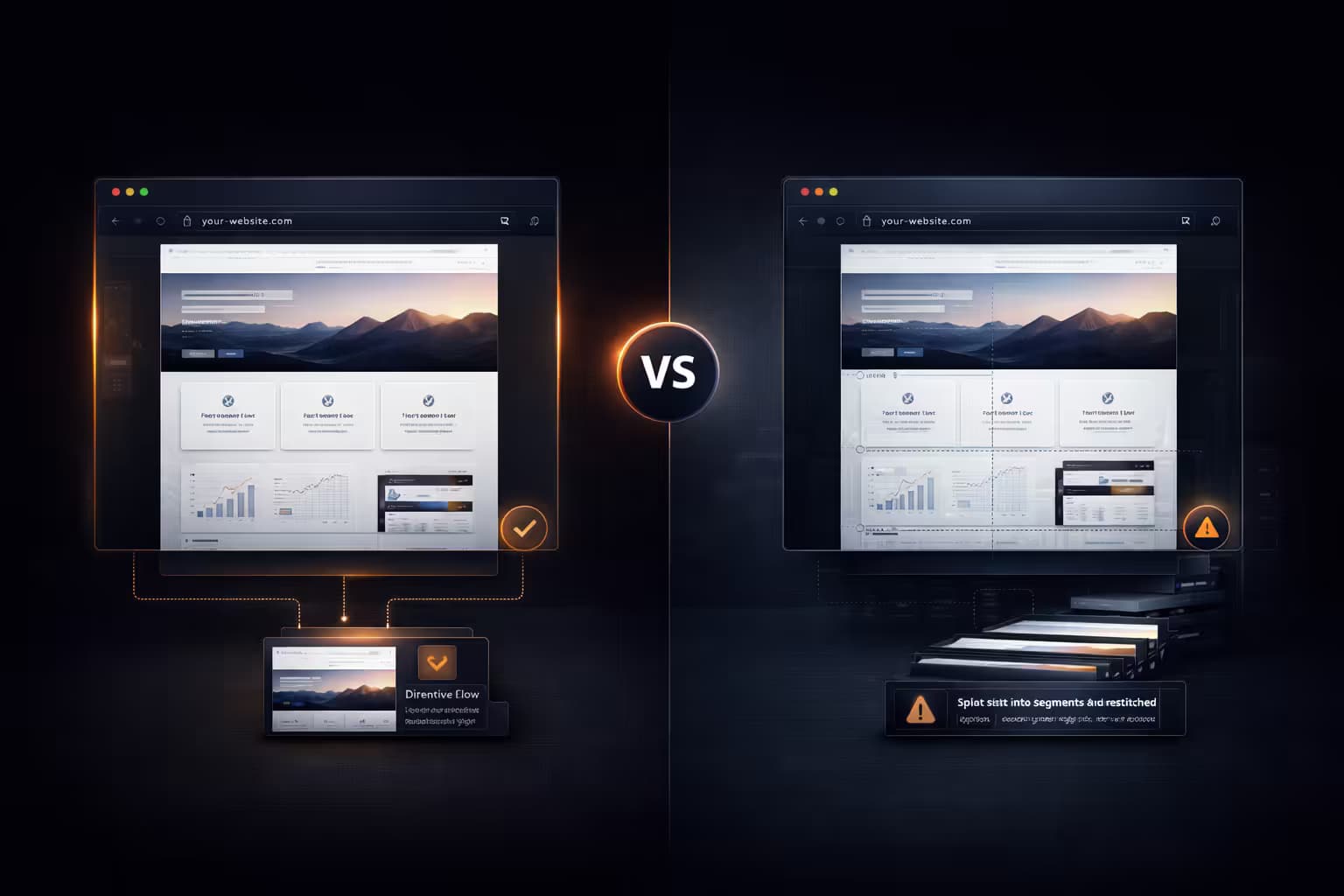
Visual diff. No comparison endpoint appears in CaptureKit's documented feature set. POST /api/v3/compare is the reason most of our monitoring customers are here: two URLs in, and out comes summary.mismatchPercentage, both render dimensions, and a diff.link image with the changed pixels marked.
The work this replaces is easy to underestimate. It is not the pixel comparison — that is a library call. It is durable baseline storage, capturing both sides with identical settling behaviour, handling the very common case where the page changed height overnight, and threshold tuning against the counter-intuitive fact that a one-character price change moves about 0.01% of the pixels while a rotating hero image moves several percent. Mask dynamic regions with hide and set the threshold near zero for text-critical pages; the threshold tuning post explains why.
Page analysis. POST /api/v3/analyze returns a summary and topics (enableSummary), quality signals (enableQuality) — isBlank, hasCaptcha, httpStatus, readabilityScore — and page metadata. CaptureKit's Page Content API extracts page content, which is adjacent but not the same thing: content extraction tells you what is on the page, quality signals tell you whether the capture is trustworthy at all. The second is what keeps a monitoring archive from silently filling with bot-challenge screenshots.
Hosted MCP. We could not verify an MCP server for CaptureKit at the time of writing. Ours is hosted at mcp.snapshot-site.com/mcp with OAuth sign-in: one URL in Claude Code, Cursor, Codex or ChatGPT, an approval, and screenshot, analyze and compare become tools the assistant can call. Nothing runs locally and no API key is copied onto individual machines.
PDF. Not listed in the CaptureKit plan feature set we reviewed, so we make no claim either way — check their current docs. Snapshot Site renders PDF from the same endpoint as images via format: pdf, which matters for reporting and compliance archives where selectable text beats a picture of text.
Where CaptureKit has the edge
Stealth mode on every tier. Bot-resistant rendering from the free plan up, not gated behind an upgrade. We handle protected and JavaScript-heavy pages too — see reliable screenshots of bot-protected pages — but if plan-level clarity about it matters to you, theirs is explicit.
A dedicated Page Content API. Content extraction as its own endpoint rather than a format flag is a cleaner design for pure extraction work. Our equivalent is format: html, which returns the full rendered DOM and leaves the parsing to you or to a model.
Mid-tier price. $29 for 10,000 credits is a strong number at exactly that volume — though our Ultra covers 15,000 for €20, so the advantage is narrow and disappears as soon as you grow into it.
Free tier volume. 100 credits a month against our 50.
The overlap is real
It is worth being clear that for a plain capture workload, these two products will feel very similar. Both render fully-loaded pages, both suppress cookie banners, both offer multiple output formats and caching, both write to S3-compatible storage in some form, and both cost about the same at the bottom of the ladder.
That means the decision should rest on the non-overlapping parts rather than on rendering quality, which you should verify yourself anyway. Run ten of your own URLs through both free tiers and compare the output — that is a better input than any comparison article, this one included.
Three volumes, worked through
Plan ladders decide more migrations than feature lists do, so it is worth placing your actual volume on both.
1,000 captures a month. CaptureKit Starter is $7, our Pro is €7. A tie, and not a reason to move in either direction on price alone.
15,000 captures a month. This is where the ladders diverge. Our Ultra covers it for €20. On CaptureKit you are above Pro's 10,000 credits and into Ultimate at $89 for 50,000 — paying for 35,000 credits you will not use. Fifteen thousand is not an arbitrary number, either: it is 500 pages checked once a day, which is what a mid-sized monitoring workload looks like.
50,000 captures a month. CaptureKit Ultimate at $89 is competitive here, and our published ladder tops out at Mega AI, €39 for 30,000 requests with AI analysis included. Above 30,000 the conversation moves to plan tiers rather than a table, so check the pricing page rather than extrapolating.
The pattern is that the two products are priced alike at the bottom, diverge sharply in the middle where most production monitoring sits, and converge again at high volume. Most teams are in the middle.
Failure modes, and what each product tells you
Rendering quality is similar enough that the more useful comparison is what happens when a capture goes wrong.
Every automated pipeline eventually captures something that is not the page: a bot-challenge wall, a blank shell where a client-side app failed to hydrate, a soft 404 that returns HTTP 200 with an empty layout. The capture succeeds in all three cases. A valid image is produced, the job reports success, and nothing surfaces until someone opens the archive weeks later.
POST /api/v3/analyze with enableQuality: true answers exactly that question — isBlank, hasCaptcha, httpStatus, readabilityScore — so the pipeline can reject a bad capture at the moment it happens rather than storing it.
Snapshot Site also returns some errors as HTTP 200 with an error body:
{ "status": "error", "message": "Url must match format \"uri\"", "error": true, "errorCode": "invalid_request", "retryable": false }
Branch on error === true rather than on the status code alone, and use retryable to decide whether another attempt has any chance. It is a small integration detail that saves a class of silent failure — and it is the kind of thing worth checking on any capture API you evaluate, including CaptureKit.
Evaluating both in thirty minutes
Both free tiers cover a real test: 100 credits there, 50 here.
Pick ten of your own pages, weighted toward the awkward ones — a client-side-rendered app, a cookie wall, a lazy-loading grid, a very long page. Capture all ten on both at 1280 wide, full page, cookie banners suppressed, and compare the results for the failures that actually matter: a covered fold, grey placeholders instead of images, a capture that stops short of the real page height.
Then capture one page twice here and run both through /api/v3/compare. The mismatch percentage and diff image have no counterpart to test on the other side — which is the difference the rest of this article is about.
What tips it
Strip out everything the two products share and a short list remains, all of it on one side.
Comparison exists here and nowhere in CaptureKit's documented feature set — and comparison, not capture, is what monitoring workloads are actually buying. Quality signals tell you whether a capture is trustworthy before it reaches your archive. PDF comes off the same endpoint as images, which their plan features do not list. And the hosted MCP server with OAuth means an assistant in Claude Code, Cursor, Codex or ChatGPT can use all three operations without a local process or a distributed key.
Against that, CaptureKit's advantages are a slightly larger free tier and a mid-tier price that our Ultra beats on volume. The overlap is real, but the parts that do not overlap all point the same way.
Choosing
Pick Snapshot Site if you need comparison as an endpoint, if you want quality signals gating your pipeline, if PDF output matters, or if you want AI assistants connected through a hosted OAuth flow rather than not at all.
For the wider decision, Snapshot Site vs ScreenshotOne and Snapshot Site vs ApiFlash cover the two closest alternatives in this space, and the ScreenshotOne alternative page has a full migration mapping if you are coming from there instead.
Start free with 50 captures a month at Snapshot Site.